

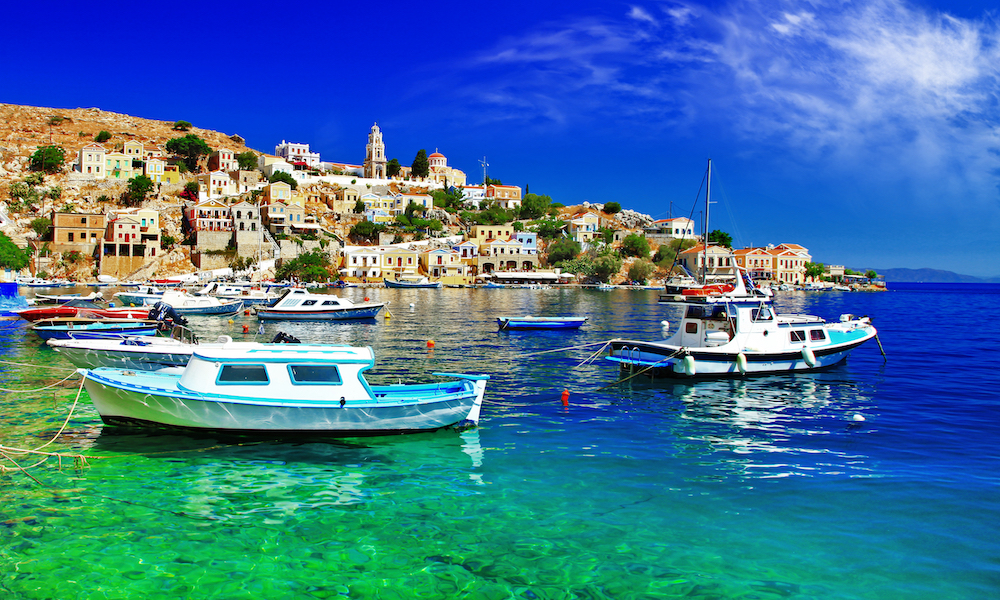
Azure seas and sun-kissed beaches; whitewashed villages and striking blue-domed churches… the Greek Islands are so beautiful you’d think they were a gift from the gods themselves.
However, there’s a lot more to these stunning island paradises!
1. There are a lot more islands than you may think
Mykonos and Santorini are household names, yet there are actually 6,000 Greek islands and islets in total. And only around 230 of them are inhabited!

2. Seafood is the main source of food
If you take a look at a map of Greece, it’s easy to see why fish is such an important part of the Greek diet. For such a small country there’s a lot of coastline and a strong culinary history with fish, shellfish and other seafood. From slippery sardeles (sardines) and gavros (anchovies) to kolios (mackerel) and a Greek type of lobster (astakos), the mighty Aegean Sea is home to some of the most incredible seafood in the world.
3. There are two pink sand beaches in Greece – both found on Crete!
Blush pink beaches are rare. They’re created by the broken shells of a unique microorganism, that has washed up on a beached and mixed with the sand to create a pinkish hue. Only a handful of these beauties exist in the world, and two are on the island of Crete.

4. Everyone gets lost in Mykonos – there’s a good reason!
Feel like you wandered up and down the same street, at least a dozen times, on a visit to Mykonos? You probably did – and it’s intentional! The streets of Chora, better known as Mykonos Town, were designed in a maze-like fashion to confuse invading pirates, as well as provide a little respite from the strong northern winds that buffer the island during the summer months.

5. Tuesday the 13th
While Friday the 13th is the day most of the world gets a little bit nervous, Greeks believe Tuesday the 13th to be a day of absolute bad luck. It spoils the notion of the 12 gods of Olympus, 12 months, 12 hours of the day and 12 of the night. Then there’s the 12 labours of Hercules, the 12 zodiac signs and more.
6. Blue doors keep away evil spirits
Ever wondered why so many of Greece’s islands are awash with beautiful blue and white houses? According to ancient beliefs, this particular shade of blue keeps evil away. The locals call the colour kyanos. It is where the words cyan (blue) and cyanide (poison) were derived.

7. Santorini is an active volcano
The island of Santorini is in fact an active volcano! Although currently dormant, scientists have found evidence for at least 12 large eruptions in the last 200,000 years. The most recent shook the shores of Santorini in 1950.

8. The Greek Islands are bathed in sunshine almost 300 days a year
It’s easy to understand why the locals are always smiling, with sunshine 85% of the year. Not to mention the pristine beaches, mouth-watering cuisine and a laid-back Mediterranean mentality. It’s hard not to live the good life on one of Europe’s favourite holiday destinations!

9. The olive trees on Crete are old… really, really old
The Koroneiki olive trees found on the island of Crete are estimated to be 3000 years old, with ancient cultivation methods to create the olive oil dating back to 4000 B.C.

10. The oldest toy in the world is Greek!
Yo-yo’s were invented in Greece around 500 B.C. Made from terracotta, the toys were given to children ceremoniously when they came of age.

Ready to go? Check out TripADeal’s Greek Island holidays and more here.